
A process diagram is the one Task 1 question with no data in it. No figures to select, no trends to compare, nothing to round.
That makes it feel easier. It is where candidates who score 7 on charts quietly drop to 6.
Processes are marked on things charts never test. Whether you control the passive voice. Whether you can group stages instead of listing steps. Whether your overview says anything at all.
Natural or Man-Made?
Answer this before you write, because it sets the grammar of your whole answer.
Most advice tells you to “use the passive voice” and stops there. That advice is half right and it costs marks.
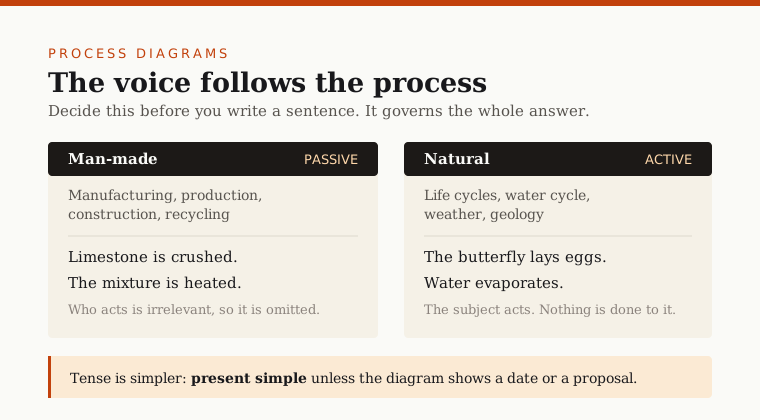
Man-made processes take the passive. Manufacturing, production, construction, recycling. Limestone is crushed. The mixture is heated to 1,400°C. The cement is packed into bags.
Someone performs each action, but who they are is irrelevant. Naming them — “workers crush the limestone” — reads as informal and gets repetitive fast.
Natural processes take the active. Life cycles, the water cycle, weather, geological change. The butterfly lays eggs on a leaf. The larva emerges after ten days. Water evaporates from the ocean surface.
Nothing is being done to these subjects. They act. Force the passive here and you produce the classic error: “The eggs are laid by the butterfly.” It is grammatically correct, it is unnatural, and it tells the examiner you memorised a rule without understanding it.
Flexible, accurate control of both voices reads as band 7. Rigid overuse of the passive, or malformed passives, reads as band 6.
Process Diagram Structure
- Introduction, about 25 words. Paraphrase the prompt: what the diagram shows and, if stated, where.
- Overview, about 40 words. The shape of the process. Covered below.
- Body one, about 55 words. The first logical stage.
- Body two, about 50 words. The second, through to the final output.
There are no figures to select here, so every word does descriptive work. The grouping decision carries more weight than on a chart, not less.
The Introduction
Process prompts are short, sometimes ten words, so you have less to paraphrase than on a chart task.
You may combine the introduction and overview into one opening paragraph, as long as they stay distinct sentences. This is the one Task 1 type where that is accepted.
The Overview
Write the overview second, not last. That way you cannot omit it when time runs out.
Every Task 1 answer needs an overview. On processes there is one specific trap, and it is the memorised template:
Overall, the process consists of seven stages, beginning with the collection of raw materials and ending with distribution.
That sentence is safe, grammatical and worth very little. It counts the boxes on the page. It does not say how the process works, and examiners flag it as limiting Task Achievement.
Put these in instead:
- How many main stages, and the start and end points
- Whether the process is linear or cyclical. A life cycle that returns to its beginning is a different shape from a production line. Saying so proves you read the diagram instead of transcribing it
- Whether it mixes manual and mechanical operations, if it does
- For two diagrams, the key feature of each and the relationship between them. This is not optional. Describe both without connecting them and you lose marks
The Body Paragraphs
Group the stages. Do not narrate the steps.
The band 6 answer gives every box in the diagram a sentence. Seven boxes, seven sentences, in order.
The band 7 answer sorts the boxes into two logical stages and gives each one a paragraph. Preparation and processing. Transformation and output. Collection and treatment.
That grouping is your idea about the process. Having one is the difference between a report and a caption.
Look for the natural break. The moment the material changes state. The point where a machine takes over from a person. The transition from raw input to finished product.
Process Diagram Language
Tenses
If the diagram shows a general, ongoing process with no dates, use the present simple throughout. That is the default and it covers almost every process task you will see.
Change it only when the diagram forces you to. A historical process takes the past simple. A proposed future development takes future forms or modal passives: the water will be filtered, the site is to be redeveloped.
Sequencing
Carry the sequence through structure, not through sequencers. Coherence and Cohesion rewards logical progression, not the number of linkers you fit in.
The band 6 pattern is unmistakable: Firstly… Secondly… Next… Then… Finally… Every sentence opens with a sequencer and the whole thing reads like assembly instructions.
Use grammar to do that work instead:
- participle clauses — Once cooled, the glass is cut
- time clauses — After the mixture has settled, it passes into…
- relative clauses that connect one stage to the next
Where you do use a sequencer, vary it: initially, at this point, subsequently, thereafter, meanwhile, ultimately, the process concludes with.
The answer is only 170–190 words, so use each linking word once. If you have used “then”, it is spent.
How It Is Marked
Four criteria, equally weighted: Task Achievement, Coherence and Cohesion, Lexical Resource, Grammatical Range and Accuracy.
The overview is the threshold feature on Task Achievement, and it ladders the same way as it does for a chart:
- Band 5 — recounts detail mechanically, with no clear overview
- Band 6 — a relevant overview is attempted
- Band 7 — presents a clear overview, with the main stages identified
“Attempted” is what the counting template gets you. “Clear” needs the shape: linear or cyclical, what changes, what drives it.
Two criteria carry more weight here than on chart tasks.
Grammatical Range and Accuracy is doing more work. Processes are the only Task 1 type that specifically tests passive construction.
Coherence and Cohesion is judged on progression, not connectives. The answer is short, so a repeated linker is conspicuous.
Three Task Achievement Penalties
These cost you marks regardless of how well the answer is written.
Knowledge from outside the diagram. Describe only what is drawn. If the diagram ends with bagged cement, your answer ends there. Writing that the bags are “then sold to construction firms” is invention, however plausible it sounds.
Missing or reordered stages. Include every major stage shown, in the order shown. Jumping backwards damages Task Achievement and Coherence together.
Evaluating the process. No opinions on whether it is efficient, clever or wasteful. Comparing structural complexity is fine where it is a visual fact — concrete production involves fewer stages than cement production — because that is observation, not judgement.
On Grammatical Range and Accuracy the band 7 requirement is frequent error-free sentences. Do not pack four actions into one sentence to prove range. You get run-ons and comma splices, and you score below the same content written as three clean sentences.
Process Diagram Sample
An original task in the standard format. It is a man-made process, so it takes the passive throughout — and it returns to its starting point, which the overview has to say.
The diagram below shows how glass bottles are recycled.
Summarise the information by selecting and reporting the main features, and make comparisons where relevant.
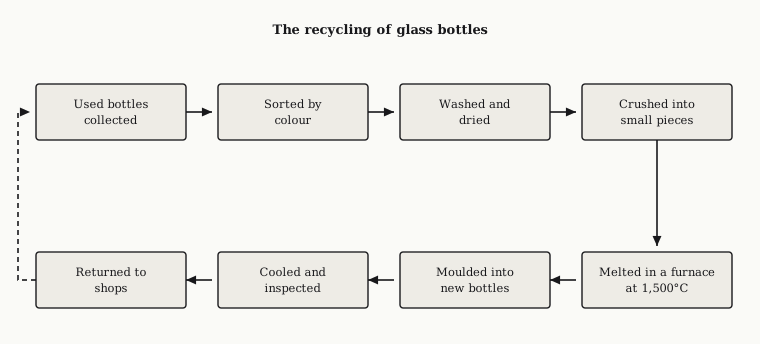
Two things to notice before writing. It is manufacturing, so the voice is passive. And the final stage feeds the first, so the process is a loop rather than a line — which is exactly the kind of observation the overview is marked on.
Band 6 Model Answer
The diagram below shows how glass bottles are recycled. Overall, there are eight stages in the process, beginning with collection and ending with the bottles going back to shops.
Firstly, used bottles are collected from the people who have finished with them. Secondly, the bottles are sorted by colour, because different colours of glass cannot be mixed together in the furnace. Thirdly, the bottles are washed and then they are also dried. Next, they are crushed into small pieces by a machine. Then the small pieces of glass are put into a big furnace and they are melted at a temperature of 1,500°C. After that, the melted glass is moulded into the shape of new bottles. Then the new bottles are cooled down and they are inspected. The inspection is done to check that the bottles are not broken or damaged in any way. Finally, the finished bottles are delivered to shops.
152 words, and every one of them accurate. It is still a band 6 answer.
The introduction is copied from the prompt, so it is discounted. The overview counts the boxes rather than describing the process, which is what “attempted” means in the descriptor. Every stage gets its own sentence in diagram order, so there is no grouping. Six sentences open with a sequencer. And the loop — the single most reportable feature on the page — is never mentioned.
Band 7 Model Answer
The diagram illustrates the stages by which used glass bottles are processed and returned to sale as new ones.
Overall, the process is continuous rather than linear, since the finished bottles re-enter the same cycle once they have been used. It divides into two broad phases: the preparation of the waste glass, and its conversion into new containers.
In the first phase, bottles that consumers have discarded are gathered and separated according to their colour. Once sorted, they are washed and left to dry before being broken down into small fragments, which is the point at which the original bottles cease to exist as objects.
The second phase transforms this material. The fragments are heated in a furnace at a temperature of 1,500°C until they liquefy, and the molten glass is then shaped in moulds to form new bottles. After being allowed to cool, these are checked for faults and distributed to retailers, from where they will eventually re-enter the process.
161 words — inside the 150 to 190 range this guide recommends.
Six Differences
The introduction is paraphrased. “The stages by which used glass bottles are processed and returned to sale” replaces the prompt’s wording, so all of it counts toward the 150.
The overview names the shape. Continuous rather than linear is the observation the diagram was built around, and the band 6 answer misses it entirely while counting eight stages instead.
The stages are grouped into two phases. Preparation, then conversion. That is one idea about the process rather than eight sentences about eight boxes, and it is what “appropriately categorised” rewards.
The sequence is carried by grammar, not by sequencers. Once sorted, before being broken down, After being allowed to cool — participle and time clauses. There is not a single firstly or next in it.
The passive is used flexibly. Are gathered, are washed, are heated, being allowed to cool. Note also bottles that consumers have discarded — an active relative clause inside a passive paragraph, which is the flexibility band 7 asks for rather than rigid passive throughout.
Nothing is invented. The answer stops at distribution to retailers, because that is where the diagram stops. The band 7 version adds no detail about what happens in the shops.
Do’s and Don’ts
| Do | Don’t |
|---|---|
| Decide natural or man-made before writing | Default to the passive for everything |
| Use the passive for manufacturing and production | Write “the eggs are laid by the butterfly” |
| Use the present simple unless the diagram is dated | Shift tense between paragraphs |
| Say whether the process is linear or cyclical | Say only how many stages there are |
| Group the steps into two logical stages | Give each box in the diagram its own sentence |
| Vary the sequencers, using each once | Open every sentence with Firstly, Secondly, Next |
| Describe only what is drawn | Add what happens next in the real world |
| Break long stages into linked sentences | Pack four actions into one sentence |
Practice
Four habits carry this task type. Pick the voice from the process. Write a real overview. Group the stages. Vary the linkers.
You build those by writing answers and getting them marked, not by reading about them.
You can check a Task 1 answer with the IELTS writing checker: paste the question and your response for an estimated band. It marks all four criteria separately, so you can see which one is capping your band.
Related: how to describe a line graph covers the data-based tasks, how to describe mixed charts covers tasks with two visuals, IELTS Writing Task 1 explained covers format and timing, and how the writing band scale works explains what each criterion rewards.
Frequently asked questions
- Should I use the passive voice for a process diagram?
- Only for man-made processes. Manufacturing, production, construction and recycling take the passive, as in limestone is crushed. Natural processes such as life cycles and the water cycle take the active, because nothing is being done to the subject. Writing that the eggs are laid by the butterfly is the classic error.
- What tense should I use for a process diagram?
- Present simple throughout, for any general ongoing process with no dates, which covers almost every process task you will see. Change it only when the diagram forces you to: a historical process takes the past simple, and a proposed development takes future forms or modal passives.
- What should a process diagram overview say?
- More than how many stages there are. Counting the boxes is safe, grammatical and worth very little. Say whether the process is linear or cyclical, where it starts and ends, and whether it mixes manual and mechanical operations. With two diagrams, name the key feature of each and the relationship between them.
- Should I use 'firstly, secondly, next, finally' in a process answer?
- Use them sparingly and vary them. Opening every sentence with a sequencer reads like assembly instructions, and Coherence and Cohesion rewards logical progression rather than the number of linkers. Carry the sequence with participle clauses and time clauses instead, as in once cooled, the glass is cut.
- How many words should a process diagram answer be?
- 150 to 190. There are no figures to select on a process task, so every word does descriptive work, and each linking word should be used once. If you have used 'then', it is spent.
- Can I describe what happens after the diagram ends?
- No. Describe only what is drawn. If the diagram ends with bagged cement, your answer ends there. Writing that the bags are then sold to construction firms is invention, however plausible it sounds.