
Maps carry no data. No figures to select, no trends to round, nothing to approximate.
What they test instead is precision of a different kind: whether you can say where something is without pointing at it, and whether you can compare two pictures rather than describe them one after the other.
Most answers fail on the second. They describe the first map, then describe the second map, and never put the two in the same sentence.
The decision that fixes it: divide the map, not the timeline.
Divide the Map, Not the Timeline
Your two body paragraphs should be two areas, not two dates.
The sources are direct about this. “The most coherent structure for a two-map response is to divide the area spatially rather than describing one map fully before the other.” Group the changes by zone — northern and central in one paragraph, southern and eastern in the other — and inside each paragraph compare what was there before with what replaced it.
That single choice produces comparison automatically. “The farmland in the north was replaced by a housing estate” is one sentence covering both maps. Write chronologically instead and you get two descriptions with nothing joining them, which is the same structural error that caps pie chart answers at band 6.
There is one more thing this structure makes easy, and it is the mark most candidates leave on the table.
Say what did not change. Noting what stayed is as analytically important as noting what went. “The church remained in its original position east of the green” proves you read the whole map rather than hunting for differences. Band 6 answers list only what was built and what was demolished.
Map Structure
- Introduction, about 25 words. Paraphrase the prompt. Name the place and the two time periods.
- Overview, about 40 words. The most significant overall change, plus whether anything was retained.
- Body one, about 55 words. One half of the map, with precise locations.
- Body two, about 50 words. The other half, including what was kept.
Write 150 to 190 words. Under 150 is penalised. Over 210 and you are listing features rather than selecting them.
The Overview
Name the transformation, not the inventory.
A strong map overview says what the place became — more urbanised, shifted from agriculture to housing, converted from industry to leisure. Then it notes whether any part was left alone.
“Overall, the settlement changed from a working fishing village into a tourist destination, although its historic centre was left intact.” That is the whole map in one sentence, and it is what “clear overview” means in the descriptor.
The band 6 version counts things: the maps show several changes between 1990 and today. True, and worth nothing.
The Body Paragraphs
One paragraph per zone, and inside each one, before against after.
Select. A detailed map may carry fifteen or twenty labelled features, and “describing every one of them produces a list, not an analysis”. Lead with the changes that transformed large areas, and group small ones together in a single clause.
Map Language
Tenses
This is the most commonly examined grammar point on map tasks, and it depends entirely on which of the three map types you have.
| What the maps show | Map 1 | Map 2 |
|---|---|---|
| Two past dates — 1950 and 2000 | past simple | past simple with change verbs |
| Past and present — 1990 and now | past simple | present perfect or present simple |
| Now and a proposed plan | present simple | future simple or modal passive |
So: “the farmland was converted into a residential zone” for two past dates. “A new bridge has been constructed to the north” for past against present. “The car park is planned to be replaced by a shopping centre” for a proposal.
Check the labels on the maps before you choose. A plan for a future development takes different grammar from a historical comparison, and using the past simple on a proposal is an error the examiner cannot miss.
Location and Direction
Maps are the one Task 1 type where the vocabulary is spatial rather than numerical, so this earns its own list.
The band 6 giveaway is informal position language — in the top part, on the right side — and next to used for every relationship on the page.
| Job | Language |
|---|---|
| Cardinal | to the north / south / east / west of |
| Ordinal | to the north-east / south-west of |
| Relative | adjacent to, alongside, bordering, opposite |
| Proximity | near, close to, in the vicinity of |
| Central | in the centre of, at the heart of, centrally located |
| Peripheral | on the outskirts of, at the edge of, on the periphery of |
| Along a route | along the river, on the northern bank, at the junction of two roads |
Two more worth having: perpendicular to for something meeting a road at right angles, and clockwise for working your way round a circular feature.
The Passive, and the Verbs of Change
Map changes take the passive, because who did the building is irrelevant and never shown.
- Built — was built, was constructed, was developed, was erected, was established
- Removed — was demolished, was knocked down, was cleared, was replaced by
- Made bigger — was extended, was expanded, was enlarged
- Turned into — was converted into, was transformed into, was redeveloped as
- Moved — was relocated to, was transferred to
- Kept — remained in place, was retained, was unchanged, continued to occupy
That last row is the one candidates never learn, and it is how you report the features that stayed.
How It Is Marked
Four criteria, 25% each. On maps, Task Achievement caps most competent answers, and once again it is the overview.
- Band 5 — “Key features which are selected are not adequately covered. The recounting of detail is mainly mechanical.”
- Band 6 — “Key features which are selected are covered and adequately highlighted. A relevant overview is attempted.”
- Band 7 — “presents a clear overview, the data are appropriately categorised, and main trends or differences are identified.”
Two criteria carry unusual weight here.
Grammatical Range and Accuracy is doing more work than on a chart, because maps test both the passive voice and a tense pairing that changes with the task. Both are visible in every sentence.
Lexical Resource is tested through location vocabulary specifically. The band 7 descriptor asks for enough range “to allow some flexibility and precision”, and on a map that means not writing next to six times.
Map Sample
An original task in the standard format. The maps show the past against the present, so the second one takes the present perfect.
The maps below show the coastal village of Stanford in 1990 and today.
Summarise the information by selecting and reporting the main features, and make comparisons where relevant.
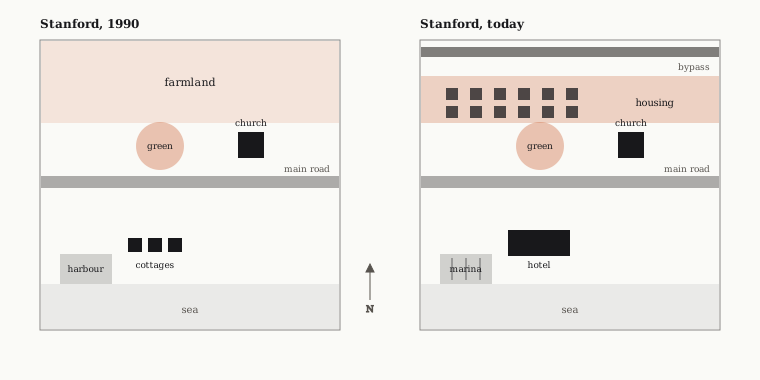
Two zones do all the work. The north gained housing and a road; the waterfront in the south turned from working harbour to leisure. The centre barely moved — and that is worth a sentence, not silence.
Band 6 Model Answer
The maps below show the coastal village of Stanford in 1990 and today. Overall, there are many changes between the two maps.
In 1990, there was farmland in the north of the village. There was a green in the middle and a church next to the green. There was a harbour in the south-west and next to it there were three cottages. There was a main road.
Today, there is a housing estate in the north and a new bypass. The harbour is now a marina. Next to the marina there is a hotel. The green and the church are still there.
Nothing in it is untrue. It is capped at 6, and the structure is why — map 1, then map 2, so no sentence ever compares the two. Next to appears three times, and there is or there was opens almost every sentence.
Band 7 Model Answer
The two maps illustrate how the coastal village of Stanford has developed from 1990 to the present day.
Overall, the village has grown considerably and shifted from a working fishing settlement towards residential and tourist use. Its historic centre, however, has been left largely untouched.
The most extensive change has taken place in the north, where the farmland that once covered the upper half of the village has been cleared and built over with a large housing estate. A bypass has also been constructed along the northern edge, running parallel to the original main road, which itself remains in place.
The waterfront has been redeveloped for leisure. The harbour in the south-west has been converted into a marina, and the fishermen’s cottages that stood to its east have been demolished and replaced by a hotel. Between the two, the village green and the church on its eastern side are unchanged.
Six Differences
The introduction is paraphrased. “How the coastal village of Stanford has developed” replaces the prompt’s wording, so all of it counts toward the word limit.
The overview names the transformation. Fishing village to residential and tourist use, with the centre preserved. That is an interpretation of the maps, not a count of what is on them.
The paragraphs are zones, not dates. North in one, waterfront in the other. Every sentence spans both maps because it has to — the farmland has been cleared and built over, the harbour has been converted.
The tense pair is right. 1990 against today means present perfect for the changes: has been cleared, has been constructed, has been converted. Band 6 uses there was and there is, which describes two states and no change.
Location language is precise and varied. Along the northern edge, parallel to, to its east, on its eastern side, in the south-west. Band 6 reaches for next to three times.
What stayed is reported. The main road, the green and the church are all named as unchanged. Band 6 mentions the green and church in passing; the road’s survival is never noticed at all.
Do’s and Don’ts
| Do | Don’t |
|---|---|
| Split the answer into two areas of the map | Describe map one, then map two |
| Compare before and after in the same sentence | Write two separate descriptions |
| Check which of the three map types you have | Use the past simple on a proposed plan |
| Say what was retained or remained in place | Report only what was built and demolished |
| Use to the north-east of, adjacent to, bordering | Write in the top part or on the right side |
| Use the passive for changes | Invent who carried out the work |
| Lead with the changes covering the largest areas | List all twenty labelled features in turn |
| Name the transformation in the overview | Write that the maps “show many changes” |
Practice
Maps reward two habits. Plan the answer as zones before you write, and look deliberately for what did not move.
Both feel unnatural at first, because the eye goes straight to the differences. That is what makes them worth practising rather than reading about.
You can check a Task 1 answer with the IELTS writing checker: paste the question and your response for an estimated band. It marks all four criteria separately, so you can see which one is capping your band.
Related: how to describe a process diagram covers the other non-data task, how to describe mixed charts covers the same two-visual structural trap, IELTS Writing Task 1 explained covers format and timing, and how the writing band scale works explains what each criterion rewards.
Frequently asked questions
- What tense should I use for an IELTS map task?
- It depends on the dates. Two past dates take the past simple in both maps. A past date against the present takes the past simple then the present perfect, as in a new bridge has been constructed. A current map against a proposal takes the present simple then future forms or modal passives, as in the car park is planned to be replaced.
- How do I structure a map answer?
- Four paragraphs: an introduction of about 25 words naming the place and both periods, an overview of about 40 words giving the most significant overall change and whether anything was retained, then two body paragraphs covering one area of the map each.
- Should I describe each map separately?
- No. Divide by area, not by date. When the paragraphs are zones rather than maps, every sentence spans both maps naturally, which is what turns two descriptions into a comparison.
- Should I mention what did not change on the map?
- Yes. Saying what stayed is as analytically important as saying what went, and it proves you read the whole map rather than hunting for differences. Band 6 answers list only what was built and what was demolished.
- What vocabulary do map tasks test?
- Location and direction specifically, plus the passive voice. The band 7 descriptor asks for enough range to allow some flexibility and precision, which on a map means varying your phrasing rather than writing 'next to' six times.
- How many words should a map answer be?
- 150 to 190. Under 150 is penalised, counted after copied prompt wording is discounted. Past about 210 words you are listing features rather than selecting them.